What changes in SDSU’s art and design degrees mean for students
The School of Art and Design plans new programs in integrated design, studio art, and art history
San Diego State University’s School of Art and Design is planning a significant expansion of its academic offerings. The revamping of newly announced undergraduate and graduate degrees will reflect ever-changing creative industries, practices, and technologies.
Beginning in fall 2026, the school plans to launch a Bachelor of Arts in Integrated Design, reopen admissions for a Master of Arts in Art History, and elevate its Interior Architecture emphasis to a Bachelor of Arts in Interior and Architectural Design. A restructured Bachelor of Arts in Studio Art is also in development, with a tentative start date of fall 2027, pending final campus and systemwide approvals.
The changes are part of a broader effort to clarify degree pathways and better align the curriculum with professional practice.
“We used to have one degree and then a lot of emphasis areas within that degree,” said Matthew Hebert, director of the School of Art and Design.
Hebert explained that the degree elevation process allows students to see their major on their degree with pride, while also allowing faculty to rethink course structures and requirements.
Bachelor's degree in Integrated Design
The new BA in Integrated Design will merge SDSU’s long-standing graphic design and multimedia programs, both of which were established around 1985.
“The new program brings together graphic design and multimedia art as they are two parts of the same process,” said Arzu Ozkal, professor of graphic design.
Ozkal said the decision reflects how creative work now operates across platforms and new technology advancements.
“The growing convergence of design, technology, and media practices made maintaining two separate emphases less reflective of contemporary professional and creative environments,” she said.
The integrated structure is designed to support a wide range of interests, including UX/UI, motion graphics, publication design, and interaction design, while allowing students to build cohesive, hybrid portfolios. The first cohort is expected to begin in fall 2026.
Bachelor's degree in Interior and Architectural Design
The School of Art and Design is also planning to consolidate its emphasis on interior architecture into a single BA in Interior and Architectural Design.
“Elevating our degree from a B.A. in Art, Emphasis in Interior Architecture to a B.A. in Interior and Architectural Design is a natural step to better support our students’ readiness for professional practice,” said Yin Yu, associate professor of interior architecture
Yu said the redesigned curriculum introduces new major courses, strengthens research opportunities, and responds to fast-paced technological change in the field.
“From the industry side, the primary need is adapting to rapidly changing technologies,” Yu said. “We want to provide students with new tools and hands-on experiences with emerging technologies so they are prepared to become future leaders in the field.”
The program now introduces design research, color theory, architectural aesthetics, and digital tools such as Building Information Modeling.
“In practice, these fields are interconnected,” Yu said, referring to interior design and architecture. “Traditional disciplinary boundaries can limit our ability to understand and address design challenges holistically.”
Studio Art degree
A reimagined Bachelor of Arts in Studio Art is planned, incorporating various studio emphases such as ceramics, furniture design, painting, sculpture, and photography. These specialties will fall into one degree with flexible, student-driven pathways.
“Students can be a studio major, and there’ll be recommendations in the catalog,” Hebert said. “But it’s not enforced.”
Hebert explained the revised structure allows students to either explore broadly or focus deeply without changing majors, while maintaining access to traditional craft practices alongside media outputs.
“There are things that are happening here that I think students are pretty excited about because we haven't given up on the sort of traditional craft processes that are part of art,” Hebert said.
New and existing courses will be grouped more intentionally, including creative coding, digital fabrication, augmented and virtual reality, and interactive design.
Art History master’s program reopens
At the graduate level, SDSU plans to reopen admissions to its MA in Art History after a decade-long hold.
“When I arrived in fall 2021, there were no remaining tenure-track art historians, so rebuilding faculty was a prerequisite for reopening admissions,” said Gillian Sneed, assistant professor of art history.
The program now has the faculty capacity to support graduate mentorship and a strengthened curriculum with global and fresh perspectives.
“It is the only standalone MA in Art History in San Diego County,” Sneed said.
The first cohort is expected to begin in fall 2026.
Together, the newly updated degrees represent an inspiring initiative by the School of Art and Design to revamp its offerings in response to today’s technologies, while maintaining hands-on and creative education.
“We want the word out,” Hebert said when addressing the upcoming program additions.
For more information about the School of Art and Design and its programs, visit https://art.sdsu.edu/.
Next Story
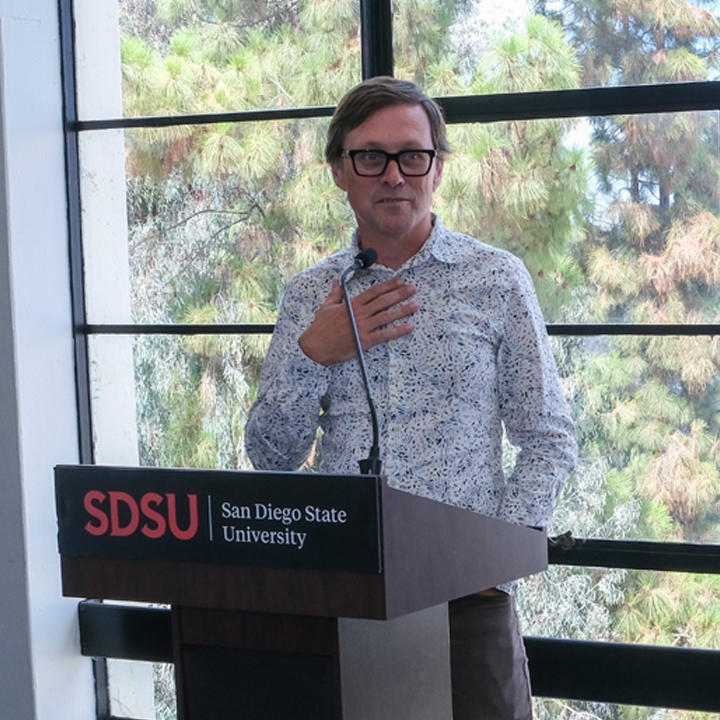
SDSU names Matthew Hebert director of the School of Art and Design
With nearly two decades at SDSU, Matthew Hebert brings industry knowledge and passion to his new role as director