Emma Löfblad turned hard hats into a heartfelt children’s story
Löfblad transformed her unexpected entry into the construction world into a children’s book that helps kids understand school modernization, highlighting safety, community connection and the often-unseen work behind campus improvements.
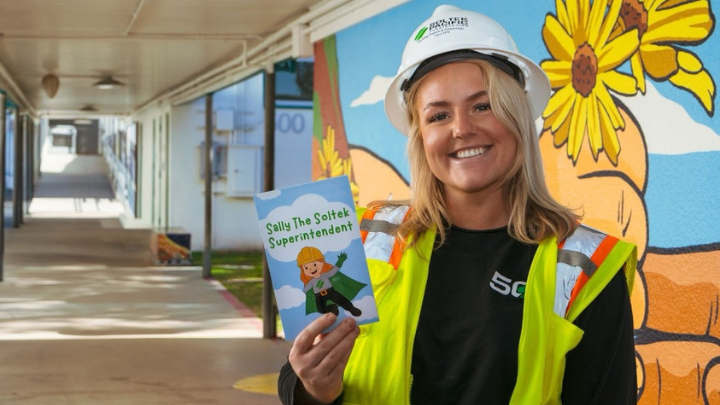
When Emma Löfblad moved from Sweden to San Diego in 2019, she never imagined her future would involve hard hats and construction sites. Now, as a graduate student at SDSU and a copywriter and content media manager for Soltek Pacific, she is turning that unexpected journey into a children’s book that helps students understand what is happening when their schools are modernized.
The idea grew out of Löfblad’s own confusion when she first entered the construction world. She realized that if she, as an adult, struggled to understand the language of construction, then kids watching demolition and rebuilding at their schools would likely be even more curious.
“You know when you don’t understand something and you have to think about it like a child? That helped me get the basics down,” Löfblad said. “It’s kind of like learning a foreign language.”
Her book introduces Sally, the construction superintendent who walks students through what is happening on campus, why the projects matter and how workers stay safe. Löfblad designed Sally’s character in Canva to be wearing personal protective equipment, also known as PPE. This refers to the gear worn on construction sites such as long sleeves, gloves and steel toed boots to protect workers from hazards.
“Women in construction was my journey,” Löfblad said. “Making Sally, the main character, female was definitely a conscious choice.”
Other characters such as Safety Manager Sage and Project Engineer Eric were developed through interviews Löfblad conducted with construction workers. She drew from their descriptions, tone and daily responsibilities, and then turned that information into playful rhyming lines that would be enjoyable for kids to read. Like Sally, they are imagined as superheroes who use their skills to keep projects moving and make schools safe.
Löfblad emphasized the importance of these interviews, explaining that she wants the voices of construction workers to come through to the children since there is not much interaction between the two. Learning what is happening on their campus not only gets them excited about the modernization of their school but also helps keep students safe.
As she settled into her role at Soltek, Löfblad realized there was an opportunity to better explain the company’s work to the broader school community. Because Soltek primarily communicates business to business, students, teachers and families don’t always see the full picture of what’s happening on their campuses. That observation inspired her to ask leadership what messages they wanted to share and how they could present them in a way that was simple, engaging and easy for kids to understand.
“If kids know what’s going on behind the fences, they may be less curious to go check it out, which is exactly what we don’t want because it’s a safety hazard,” Löfblad said.
She said that while her main goal is to help students understand the construction taking place around them, the book also gives Soltek a meaningful form of outreach. It allows the company to connect with the community, answer questions and show that modernization is about safety, progress and improving learning environments.
When first pitching her idea of creating a children’s book, Löfblad worried the concept might come across as silly. Instead, she was met with enthusiasm.
“It helped a lot that Soltek has an executive board that is very open to new ideas and very excited about new creative initiatives like this,” she said.
Soltek is now working to organize a reading hour where the book will be shared with students on a school campus. Löfblad said that hearing her co-workers’ enthusiasm and watching the idea gain momentum within the company has been the most rewarding part of the experience.
Löfblad shared that her confidence as a writer truly began at SDSU. Growing up, she struggled with imposter syndrome and didn’t view storytelling as one of her strengths, but the JMS program helped her recognize and develop that talent.
“Being able to wordsmith successfully and get your point across is a skill,” she said. “A lot of my JMS professors have helped me finesse the way I write, in terms of the rhythm, the wording and developing my vocabulary.”
As an international student, Löfblad says she developed a sense of grit while learning to navigate life in a new country. That resilience now motivates her to continue growing the characters in her story and potentially develop a follow-up book.
“There’s a lot of growing potential, and I had so much fun creating this book,” Löfblad said. “It’s definitely a passion project that I would love to do more with.”
Next Story

JMS alumna Stormy Buonantony’s versatile and award-winning sports broadcast career
Buonantony’s journey from SDSU to national sports broadcasting highlights how strong writing, relentless preparation and authenticity helped her build credibility across multiple sports and ultimately earn unique opportunities, including exclusive NHL access during the pandemic.